Biofuels and Microbial Growth: What Marine Operators Should Know

    Bottom Left Moddule Shapeing Graphic Bottom Middle Shapeing Graphic Bottom Right Shapeing Graphic

    How to Control Microbial Contamination in Marine Biofuel Storage Systems

    As the maritime industry increasingly adopts biofuels, such as fatty acid methyl ester (FAME) and their blends, to support decarbonization goals, new fuel storage and handling challenges are emerging. One growing area of concern is microbial contamination in marine fuel systems, as biofuel blends can be more susceptible to microbial growth when water is present in storage systems.

    Left unmanaged, microbial contamination can contribute to fuel degradation, filter plugging, sludge formation, biofilm buildup, and corrosion within fuel systems, leading to operational disruptions and increased maintenance requirements. Fuel preservation biocides, such as Drew Marine’s AMERSTAT 25DM and MERGAL MC14, can help control microbial growth and support long-term fuel quality and system reliability.

    In this article, we explore why microbial contamination occurs and how proactive fuel treatment strategies can help protect marine fuel systems. 


    What Causes Microbial Contamination in Marine Biofuels? 

    Bio-based fuels containing FAME, which are derived from organic biomass, generally have a higher affinity for water than conventional diesel fuels. This characteristic makes them more susceptible to microbial contamination during storage and handling, particularly when water is present in fuel tanks.

    Because these fuels are more hygroscopic and biodegradable, even small amounts of water can create favorable conditions for bacteria, yeasts, and fungi to grow at the fuel-water interface. If left uncontrolled, microbial colonies can rapidly multiply and form biofilms, sludge, and other degradation byproducts throughout the fuel system.

    Even when bunker fuel is delivered within specification for water content, over time, water can still accumulate in fuel systems during normal vessel operation. Temperature fluctuations between day and night, heated storage conditions, tank breathing, and condensation from humid marine environments can all contribute to moisture accumulation inside storage tanks. Water may also enter through contaminated bunker transfers, leaking tank vents, poor tank housekeeping, or carryover from onboard settling and service tanks. As water accumulates and settles within the fuel system, conditions become increasingly favorable for microbial growth and contamination. 

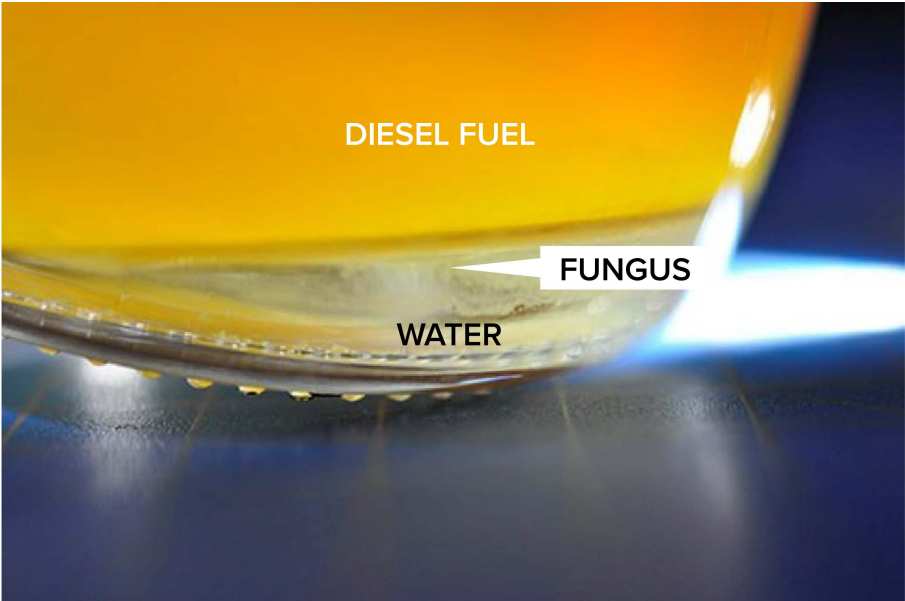
    Image 1.  Microbial contamination begins where fuel and water meet. ASTM E1259 challenge testing utilizes a fuel-water system to simulate storage tank conditions. The microbial growth visible at the interface between the diesel fuel and water layers illustrates the preferred habitat for fuel-degrading microorganisms. This region provides access to both nutrients from the fuel and water required for microbial metabolism. Biocide performance is evaluated by measuring the reduction of viable bacterial and fungal populations within this test system over time. 

    Risks of Microbial Contamination in Marine Fuel Systems 

    Uncontrolled microbial growth can have several negative effects on fuel systems:

    • Fuel Quality Degradation – Microbial activity can reduce fuel stability and contribute to the formation of unwanted degradation byproducts.
    • Sludge and Biofilm Formation – Microbes can generate sludge and biofilms that accumulate in tanks, piping, and fuel handling equipment.
    • Filter and Separator Fouling – Microbial debris can plug filters and foul separators, restrict fuel flow and increase maintenance requirements.
    • Corrosion – Microbial contamination may contribute to microbiologically influenced corrosion (MIC), particularly in areas where water is present.
    • Operational and Financial Impact – Increased cleaning, treatment, monitoring, downtime, and maintenance can lead to higher overall operating costs.

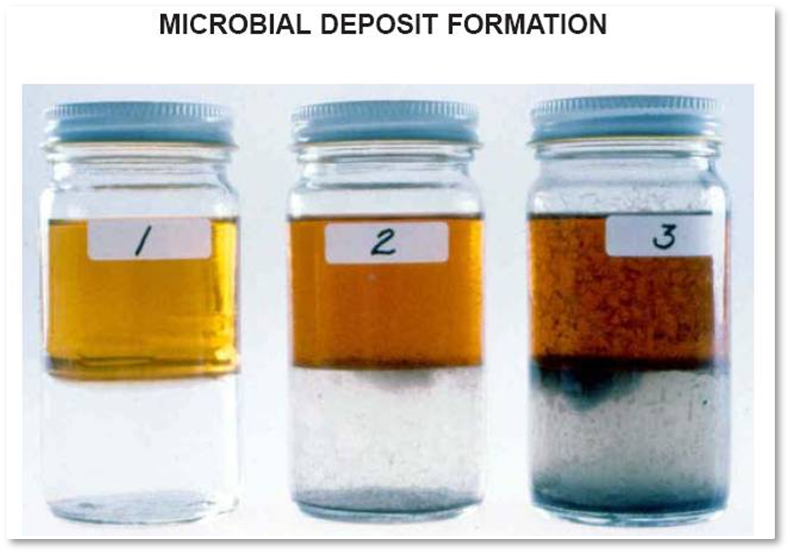
    Image 2. Representative photo of fuel-water interface and the development of microbial contamination over time.  

    How Drew Marine Biocides Help

    Fuel preservation biocides, such as Drew Marine’s AMERSTAT 25DM and MERGAL MC14 (EU Only), are specialty chemical additives designed to control microbial contamination in marine fuel storage and handling systems. These products work by disrupting microbial growth and preventing the formation of biofilms, sludge, and other microbial byproducts that can negatively impact fuel quality and system reliability.

    Key benefits include: 

    • Preserved Fuel Quality – Helps maintain fuel stability and cleanliness during storage by minimizing microbial degradation.
    • Cleaner Fuel Systems – Reduces the buildup of sludge, biomass, and biofilms that can foul tanks, filters, and separators.
    • Reduced Maintenance Requirements – Helps minimize filter plugging, tank cleaning frequency, and unplanned maintenance associated with microbial contamination.
    • Lower Corrosion Risk – Assists in reducing conditions that may contribute to microbiologically influenced corrosion (MIC) in tanks and piping.
    • Improved Operational Reliability – Supports more reliable fuel transfer, handling, and engine operation by keeping fuel systems cleaner and better protected.

    Effective microbial control should be part of a broader fuel management strategy that includes proper housekeeping, water management, routine monitoring, and corrective treatment when necessary. 

    Effective Use of Biocides in Biofuels

    For optimal protection, fuel biocides should be added to storage tanks during or shortly after bunkering to help control microbial growth before contamination becomes established. Treatment frequency and dosage should be based on factors such as storage conditions, water presence, fuel turnover, and the suspected severity of microbial contamination.

    In controlled testing, AMERSTAT 25DM and MERGAL MC14 demonstrated effective microbial reduction in biofuel applications (B30), helping maintain low microbial activity levels during storage.

    The data presented summarizes controlled ASTM E1259 Time-Kill Assessment testing conducted on B30 biodiesel fuel to evaluate the effectiveness of AMERSTAT 25DM and MERGAL MC14 against representative fungal and bacterial contaminants commonly associated with fuel microbial growth.

    Understanding ASTM E1259 Time-Kill Testing

    ASTM E1259 is a standardized laboratory method used to evaluate the antimicrobial effectiveness of a biocide over time. In this test, a known concentration of microorganisms is introduced into a treated fuel sample, and microbial populations are measured at predetermined intervals after biocide addition. Results are reported as log₁₀ reductions, which indicate the decrease in viable microbial population relative to the untreated control.

    As a reference:

    • 1 log₁₀ reduction = 90% reduction in viable organisms
    • 2 log₁₀ reduction = 99% reduction
    • 3 log₁₀ reduction = 99.9% reduction
    • 4 log₁₀ reduction = 99.99% reduction
    • 5 log₁₀ reduction = 99.999% reduction

    The higher the log reduction value, the greater the antimicrobial efficacy of the treatment.

    AMERSTAT 25DM Performance

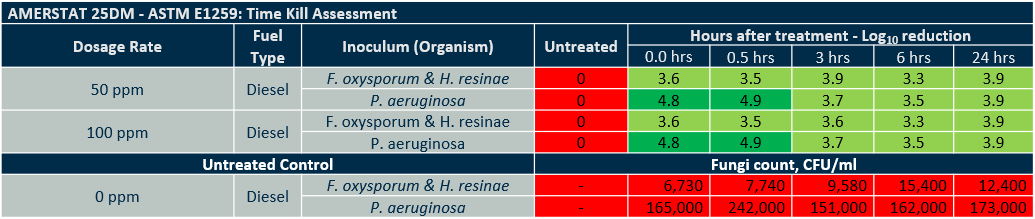
    AMERSTAT 25DM was evaluated at treatment rates of 50 ppm and 100 ppm against a mixed fungal inoculum (Fusarium oxysporum and Hormoconis resinae) and the bacterium Pseudomonas aeruginosa (Table 1).

    • Both treatment rates demonstrated rapid microbial control immediately following treatment, achieving approximately 3.5–4.8 log₁₀ reductions.
    • Microbial suppression was maintained throughout the 24-hour test period, with final reductions of approximately 3.9 log₁₀ for both fungi and bacteria.
    • The results indicate that increasing the dosage from 50 ppm to 100 ppm provided minimal additional benefit under these test conditions, demonstrating effective control at the lower dosage rate

    Table 1.  AMERSTAT 25DM – ASTM E1259 Time-Kill Performance

    MERGAL MC14 Performance

    MERGAL MC14 was evaluated at a treatment rate of 30 ppm against the same microbial challenge organisms (Table 2).

    • Fungal populations were reduced by approximately 3.5–3.9 log₁₀ throughout the test period.
    • Bacterial populations experienced particularly rapid control, reaching 5.1 log₁₀ reduction within 30 minutes and maintaining approximately 4.9 log₁₀ reduction through 24 hours.
    • These results demonstrate strong antimicrobial performance and sustained microbial control at a relatively low treatment dosage.

    Table 2.  MERGAL MC14 – ASTM E1259 Time-Kill Performance

    Untreated Control

    The untreated control samples exhibited persistent microbial populations throughout the test period.

    • Fungal counts remained between approximately 6,700 and 15,400 CFU/mL.
    • Bacterial counts remained substantially higher, ranging from approximately 151,000 to 242,000 CFU/mL.

    These untreated results confirm that microbial populations remain viable and can persist in biodiesel-containing fuels when no biocide treatment is applied.

    Test Results Summary

    Both AMERSTAT 25DM and MERGAL MC14 demonstrated rapid and sustained antimicrobial activity against representative fuel-degrading fungi and bacteria in B30 biodiesel. The ASTM E1259 time-kill results show that both products achieved greater than 99.9% microbial reduction, with bacterial reductions approaching 99.999% in some cases. The untreated controls, by contrast, maintained high microbial populations throughout the study.

    These findings support the use of preventative biocide treatment in biodiesel storage and handling systems to minimize microbial contamination, reduce the risk of fuel degradation and sludge formation, protect fuel-system reliability, and maintain fuel quality during storage.

    Protecting Fuel Quality with Good Practices

     In addition to biocide application, good fuel management practices play an important role in minimizing the risk of microbial contamination. Because microbial growth most commonly occurs at the fuel-water interface, preventing water accumulation and routinely removing free water from storage tanks are critical steps in protecting fuel quality. Maintaining a clear separation between the fuel and water layers also supports more effective drainage and onboard water separation practices.

    While some fuel treatment approaches are designed to modify the interaction between fuel and water, these technologies should be evaluated carefully to ensure they do not inadvertently create conditions that continue to support microbial activity within the fuel system. Effective microbial control is best supported through a combination of good housekeeping practices, routine monitoring, proper water management, and appropriate biocide treatment.

    As more vessels transition toward biofuels and biofuel blends, proactive fuel preservation strategies will become increasingly important to help protect fuel quality, reduce maintenance requirements, and support reliable vessel operation.

    “Incorporating biocides such as AMERSTAT 25DM and MERGAL MC14 into a proactive fuel management strategy can help reduce microbial contamination, minimize maintenance requirements, and support long-term fuel system reliability.”


    Conclusion

     As the marine industry continues to adopt biofuels, effective microbial contamination control will become increasingly important for maintaining fuel quality and operational reliability. Fuel preservation biocides from Drew Marine can help operators reduce the risks associated with microbial growth, including sludge formation, filter plugging, corrosion, and increased maintenance requirements.

    Incorporating biocides into a broader fuel management strategy that includes proper housekeeping, water management, and routine monitoring is a proactive step toward protecting fuel systems and supporting the reliable long-term use of biofuels.